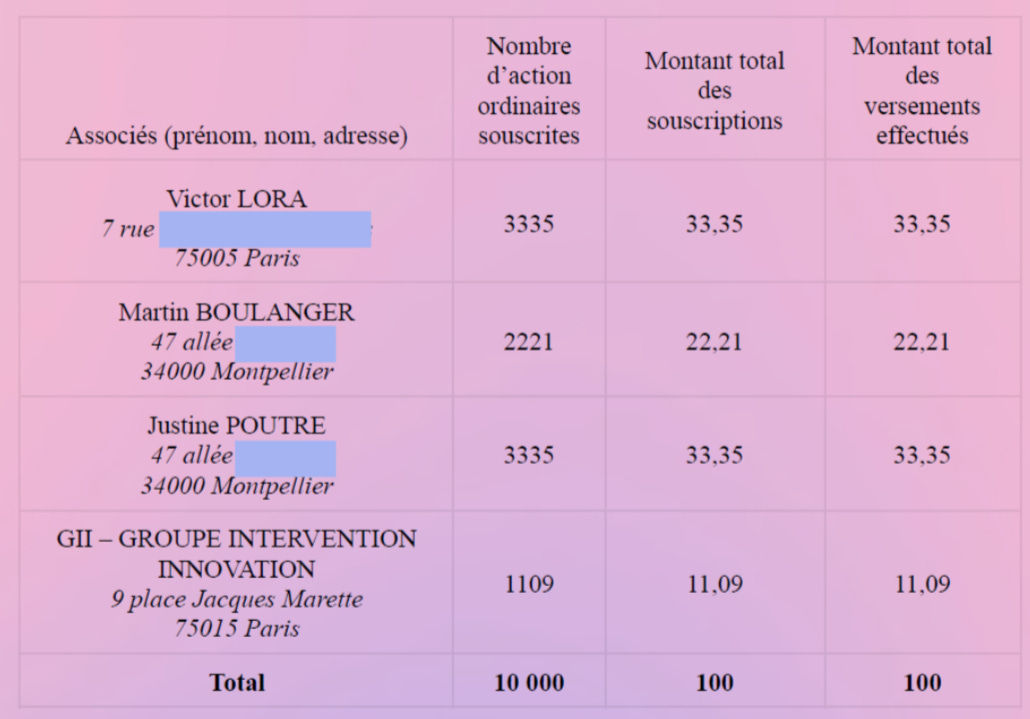
But meanwhile, Lora had launched Fire Invest in early 2022, with the same contracts. He sets out its outlines in a livestream for his community:
With Fire Invest, he explains, they are going to buy companies, restructure them and sell them on afterwards.
In reality, Fire Invest is the centrepiece of a vast empire that Lora hopes to build on three pillars, and which he explains to me:
That is how, a few months after Fire NFT’s round, Lora and Boulanger launch Fire Invest and close a €1.3M raise in October from a whole crowd of retail investors writing cheques from €10K. Often the same ones who had gone into Fire NFT.
The investment thesis wavers between VC for start-ups and buyout funds for SMEs. All for a hoped-for return of… 50% a year. In exchange for the usual 4% management fees and carried interest of 20% with a hurdle from 17% a year. And still in royalties, with the money locked up for five years.
Here again, there isn’t the slightest doubt that the fees are only there to pay for the structuring, not the management.
Which objectively makes no sense. Some VCs or managers don’t pay themselves on the money raised or on management, beyond simple structuring. That’s the case of One Green, for example, because it is actually a business angel who brings people together around her. Her business model is therefore not management, but finding people to carry more weight, and getting paid through carried interest.
The problem is that 4% is twice an average fund, and it’s what the most expensive VC funds charge, precisely because it pays for management: salaries, rent, intermediaries and so on.
You might wonder what generates more than €40K a year in fees for simple management. Questioned once again, Lora simply replies that he couldn’t decide, while telling me bluntly that these fees pay people and pay for the management. Which is normal, then. But contrary to the contracts and to what investors were told.
To win over those very investors, Fire rolls out the usual arguments:
The promises are clear. On top, Lora adds a dose of storytelling, explaining that he generates €2M a year with his ‘various’ structures, or €800K of EBITDA, and that he wants to grow, notably by finding the right companies, taking them over, running them and selling them, with a x7 per acquisition.
All with the classic Excel spreadsheet stuffed with nice-looking multiples, without ever justifying anything.
For the passive investors at the back who can’t be bothered, Victor explains that for someone investing €100K, it works out as:
€323K after five years, net of tax, for an individual, or €339K for a company: in his words, a monthly income of €5.5K over the period.
And at this point, you have to wonder how such a brilliant expert can come out with such nonsense. The €5.5K figure seems to be the average of €323K-€339K divided by 60 months. Which makes no economic sense whatsoever, since nothing is paid out.
What should actually have been calculated is the IRR:
Quite a way off the 50%, or sometimes 40%, announced in the communications. But let’s go with it.
In mid-November 2022, with Fire NFT already in ruins, Fire Invest says it has analysed four deals and approved one, for Kare School.
The investment is finally presented in a livestream in January 2023. It is announced that Fire Invest is taking 10% of Kare for €80K, valuing the company at €800K.
And at this point, to say the warning lights are flashing in every direction is an understatement.
Since the company has never declared a capital increase, you are entitled to wonder how the money was invested.
Yet during the fundraising, Lora reportedly said the company was then generating between €30K and €50K of EBITDA, according to one investor. Which is factually impossible, since it had no activity at all.
A year later, Fire Invest tells its investors it has analysed 27 projects, nine of which went through due diligence: five cancelled, three in progress and one approved. Same story six months later with 29 projects, including eight no-gos, one in progress and one approved. That’s 0.3 analyses a month…
In the end, Fire Invest will never invest in another company. But it will still make two other investments.
Every bit as surprising.