Baker puts the deals together. Marc Metrick runs the day-to-day. Thirty years at Saks, every rung of the ladder climbed, every crisis lived through. If anyone knows the luxury retail business, it’s him. On 14 February 2025, the CEO of Saks Global doesn’t send flowers for Valentine’s Day. He sends a memo to suppliers. It opens by acknowledging a problem everyone in the industry knew about but nobody had officially admitted: Saks Global owes its suppliers 18 months of invoices.29
Eighteen months.
In France, we have a name for that kind of magic trick: a Frédéric Merlin.
Then Metrick sets out the new terms. They apply immediately to all three banners: Saks Fifth Avenue, Neiman Marcus and Bergdorf Goodman. Orders will now be paid 90 days after receipt, instead of the 30 days that is the industry norm. As for the arrears, the famous 18 months of unpaid bills, they won’t be settled before July 2025, and when payments do start, they will come in 12 monthly instalments. In other words: if you’ve been owed $100K for 18 months, you’ll wait another 5 months before receiving your first payment of $8,333. You’ll be paid in full in 17 months. If all goes well. And you’ll say thank you anyway.
But the most remarkable part of the memo is the threat that comes with it. Metrick writes:
“In the absence of the normal flow of goods, we anticipate that we will have to make changes to our brand partner matrix.” If you stop delivering because we don’t pay you, we’ll kick you out of our stores. Risky business.
The memo ends with this sentence30:
“Our expectation is that this provides the clarity and certainty you have been seeking.”
You could carve it on a headstone. Saks is going to need one anyway.
The industry reacts immediately. Liza Amlani, founder of Retail Strategy Group, sums up the general mood:
Almost like a bully, she says: we’re doing this whether you like it or not, and if you won’t do it for us, we can fire you. Except that without product, Saks would fail. It wouldn’t exist.31
Saks was a house of cards built on castles in the air even before the merger with Neiman Marcus. And the merger was only seven weeks old.
Which raises an obvious question: if Saks was already not paying its bills before the merger, why take on another $2.7bn of debt to buy a competitor? The answer will come. It has nothing to do with retail.
Because in business there is one simple rule: if you don’t pay your suppliers, they stop delivering. And if your shelves are empty, customers go elsewhere.
Which is exactly what happened.
Creditsafe, a company specialising in credit-risk analysis, tracked Saks Global’s late payments throughout 2025.32 The numbers are dizzying. In July, 16.43% of invoices were more than 91 days overdue. In October, 24.46%. In November, 45.33%. In December, 47.84%.
Nearly half of all invoices paid more than three months late.
“Days Beyond Terms”, which measures how many days on average a company pays after the due date, ranged between 30 and 41 days for Saks. The industry average? 9 to 12 days. Three times slower than its competitors.
Ragini Bhalla, a spokesperson for Creditsafe, sums it up:
In 2025, Saks showed a persistent and worrying pattern of late payments, a sign of sustained liquidity problems.
The result was predictable. Suppliers stopped delivering. Mark Weinstein, the Chief Restructuring Officer appointed to try to salvage what could be salvaged, puts it in black and white:
The late payments led suppliers to hold back their inventory, disrupting Saks Global’s supply chain and leaving it without enough stock to operate successfully.
On 14 January 2026, day one of the American bankruptcy, Saks files an emergency motion: it needs $337M to pay its most critical suppliers, $126M of it in the first three weeks.33 That is the price of getting the brands back. The motion reveals one particular worry: European suppliers might consider themselves outside the court’s jurisdiction and ignore the Chapter 11 protections. French luxury houses are not in the habit of queuing up at a bankruptcy court in Houston.
Every payment is conditional on an agreement in which the supplier commits to resume deliveries on the usual terms. And if it takes the money and still refuses? Saks can claw the payment back. Mutual blackmail, drafted by lawyers.
And it wasn’t just the suppliers. That same 14 January, Saks owed $135M in overdue taxes to American tax authorities, including $105M of sales tax that was never paid over. Sixteen tax audits were under way at the same time: six in New York, five in Texas, two in California. Customers’ money that should have gone to the taxman had stayed in the till. Until there was none left.
In the second half of 2025, Saks Global received $550M less merchandise than it had planned for in July.34 $550M of products that never arrived. Empty racks in stores that pride themselves on being temples of luxury. One lender who visited the stores described the racks as “sparse and dangly”.
Saks owed $91.5M to its consignors, the brands that place their goods with the store on consignment.35 Under that arrangement, the brands keep ownership until the sale: they have a right that ordinary suppliers don’t, the right to take back their stock. That isn’t a commercial threat. It is a legal privilege.
In the bankruptcy filings, Saks acknowledges that its suppliers are irreplaceable and that for some designers, Saks is their only point of sale in the United States. In other words, Metrick’s threat in his Valentine’s Day memo (in short: we’ll kick you out of our stores) was a bluff. The brands knew it. They acted accordingly.
And of course, sales followed. According to S&P Global, revenue fell 13% in the second quarter of fiscal 2025 (May-August). It had already been -15% the year before, and -11% the year before that. Three years of uninterrupted decline.36
But the most telling contrast lies elsewhere. Throughout 2025, concession sales (where the brands manage their own stock) grew by between 2% and 18% depending on the month. Wholesale sales (where Saks buys and resells) collapsed.37 The demand was there. The customers were there. It was Saks that had nothing to sell them.
Suppliers weren’t the only problem. The merger itself had created chaos.
The Saks-Neiman Marcus merger promised $600M of synergies over five years.38 The target for year one was $150M. In his declaration to the court, Weinstein proudly announces that the company has identified $300M of synergies, double what was planned.
On paper, a triumph. In reality, a disaster.
The big synergy was the integration of the IT systems. A unified merchandising platform to optimise buying and stock allocation across the banners. Weinstein himself sings the system’s praises39:
In his telling, the platform unlocks significant margin potential by letting the company get the most out of its working capital.
The problem: in August 2025, the system crashed. Weinstein coyly refers to “merchandising system integration issues” which, he says, disrupted inventory receipts at Neiman Marcus and Bergdorf Goodman.40 The glitch began, by his account, when sales and inventory were already at a seasonal low.
In plain English: the big synergy stopped merchandise from reaching the stores during the critical run-up to the holidays. Exactly when Saks most needed to sell.
Thirteen months after the merger, Saks Global was still running 227 bank accounts spread across 11 different institutions, two separate treasury systems (Saks Legacy and Neiman Marcus), and paying $140,000 in bank fees a month.
One thing did get merged, though. On 1 January 2026, thirteen days before the bankruptcy, Saks harmonised its HR systems. Every employee (except 60 in India) is now employed by Saks & Company LLC. Monthly payroll: $87.5M. The administrative merger happened. The merger that mattered imploded.
Another figure emerges from the first-day filings: as of 1 February 2025, Saks reported $1.68bn of tax losses carried forward and $1.74bn of non-deductible interest. Total: $3.4bn of accumulated losses. You don’t celebrate $300M of synergies when you’ve dug a $3.4bn hole.
What’s the point of cutting your costs by $300M if you don’t have the cash to pay your suppliers? What’s the point of having the most optimised merchandising platform in the world if your shelves are empty? They tuned the engine of a car with no petrol.
Weinstein himself admits it, with disarming candour:
The company’s data, he explains, shows that when the stores have inventory, the inventory sells, and that no significant capital expenditure or marketing investment is needed to turn sales around.
Translation: our only problem is that we have nothing to sell.
It wasn’t Baker’s first failed bet.
In August 2021, at the height of the pandemic e-commerce boom, he decides to spin off the digital business of Saks OFF 5TH into a separate legal entity. Four companies are created. Ownership: 80% Saks Global, 20% Insight Partners, a tech private equity fund. Financing: an $85M credit line from Citibank and a $20M term loan from Callodine Commercial Finance.
The investment thesis was seductive: e-commerce is exploding during Covid, spinning off digital helps attract tech talent, and a standalone structure can raise “growth” money at a higher valuation. It was the fashion. Everyone wanted to be the next Farfetch.
Except the ROI never came. Massive investment in infrastructure, astronomical digital marketing spend, and at the end of the day: trouble shifting stock, cash running tight, no money to buy fresh stock, falling sales, even less cash. The spiral we know so well.
On 19 December 2025, Citibank blocks access to the credit line and sweeps the cash to repay itself. On 7 January 2026, Callodine sends a notice of default. The same day, a separate CRO41 is appointed, different from Saks Global’s. An independent director. Different lawyers. The filings reveal “potential claims among the parties”, unresolved intercompany claims between Saks OFF 5TH and its parent.
And inevitably, in January, SO5 Digital files for bankruptcy along with the rest of the group. But unlike Saks Global, which is trying to restructure, SO5 will be liquidated. The court authorises an “everything must go”, “going out of business” sale. The budget shows a company in wind-down mode: zero dollars of merchandise purchases, and a target closing cash balance of $5M. Just enough to cover the costs of shutting down.
Relations between SO5 and its parent were already tense. Saks Global paid the salaries of SO5 Digital’s employees, and SO5 paid it back... at 120 days. The same logic as with outside suppliers. Even in-house, it was every man for himself.
At the time of filing, SO5 Digital had $8M of cash for a business turning over $26M a month. Nine days of cash.
2021: everyone believes e-commerce is going to replace everything. 2025: e-commerce normalises and customer acquisition costs explode. 2026: liquidation. The Neiman Marcus merger is just the latest in a series of catastrophic bets.
But while suppliers were waiting for their cheques, Saks Global found money for something else: lawyers.
William Cohan is an old-school financial journalist. A former banker at Lazard and Merrill Lynch, author of bestsellers about Bear Stearns and Goldman Sachs. Since February 2025, he has been covering Saks Global for Puck, a media outlet. More than 130 articles. His diagnosis: the company is heading for bankruptcy.
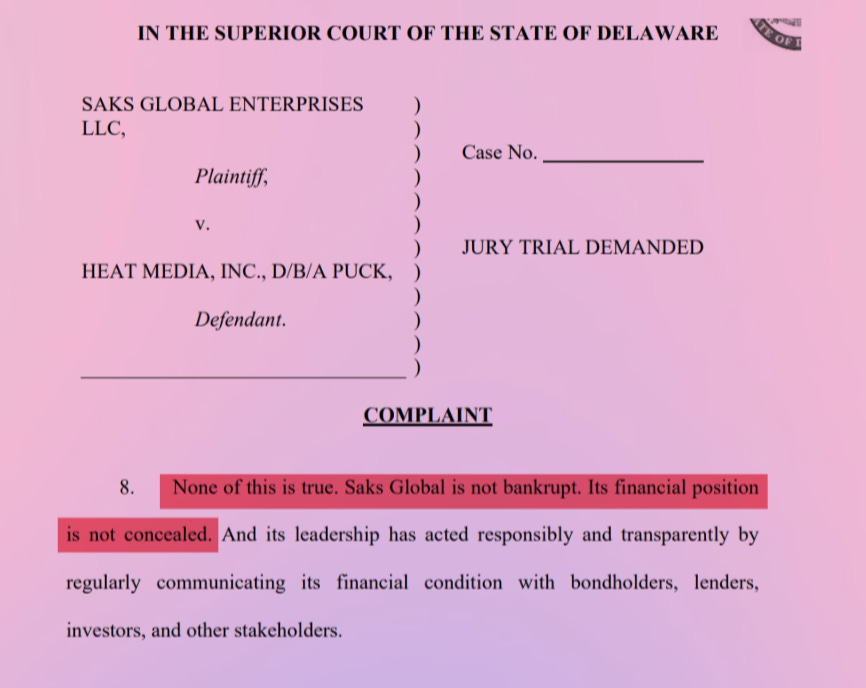
On 7 October 2025, Saks hits back. A defamation suit.42 The charge: sensationalist journalism, a campaign of deliberate falsehoods. Saks’s lawyers write with the confidence of people who still think they are in charge:
“None of this is true. Saks Global is not bankrupt. Its financial position is not concealed. And its leadership has acted responsibly and transparently.”
Three months and seven days later, Saks Global files for bankruptcy.
What Saks forgets to mention: six weeks before filing that suit, on 22 August 2025, S&P Global had rated the company “Selective Default”.43 At the very moment the lawyers were swearing everything was fine, the benchmark rating agency had already officially declared Saks in default.
Cohan had done his job. Before each story, he contacted the company. He asked questions, requested comment, checked his facts. Saks answered him. And Cohan published anyway, because the answers didn’t change the facts: the company wasn’t paying its suppliers, its bonds were trading like toxic paper, and the debt structure was unsustainable.
Saks took issue with him for writing that its bonds “traded like shit” from the moment they were issued. Wrong, said Saks: they had traded “close to par” over the winter. What Saks forgot to mention: in October 2025, as the lawyers were drafting those lines, the same bonds were trading at 35 cents on the dollar.
Saks also took issue with him for claiming the company was delaying its executives’ bonuses. “Categorically false.” We’d love to see the bank statements.
Most revealing of all: Kirkland & Ellis and PJT Partners. Cohan had written that Saks had hired these two firms, both restructuring specialists, in the spring of 2025. An obvious red flag. Saks had denied it: it had retained their “financing teams, not their restructuring departments”.
Six months later, Kirkland & Ellis is representing Saks Global in its Chapter 11 case. And PJT Partners? Authorised to provide “restructuring advisors and support personnel”. Not financing. Restructuring. Exactly what Cohan had written. Exactly what Saks had denied.
There is a legal term for this kind of action: SLAPP, Strategic Lawsuit Against Public Participation. A lawsuit whose aim isn’t to win but to intimidate. To silence. To punish whoever says what nobody wants to hear. Delaware, where Saks chose to file, has no anti-SLAPP law. That is probably no accident.
Cohan didn’t gloat when the bankruptcy came. He simply kept covering the story. The journalist was right. The company is bankrupt. And somewhere in the archives of the Delaware court, a 34-page complaint states that “Saks Global is not bankrupt”.