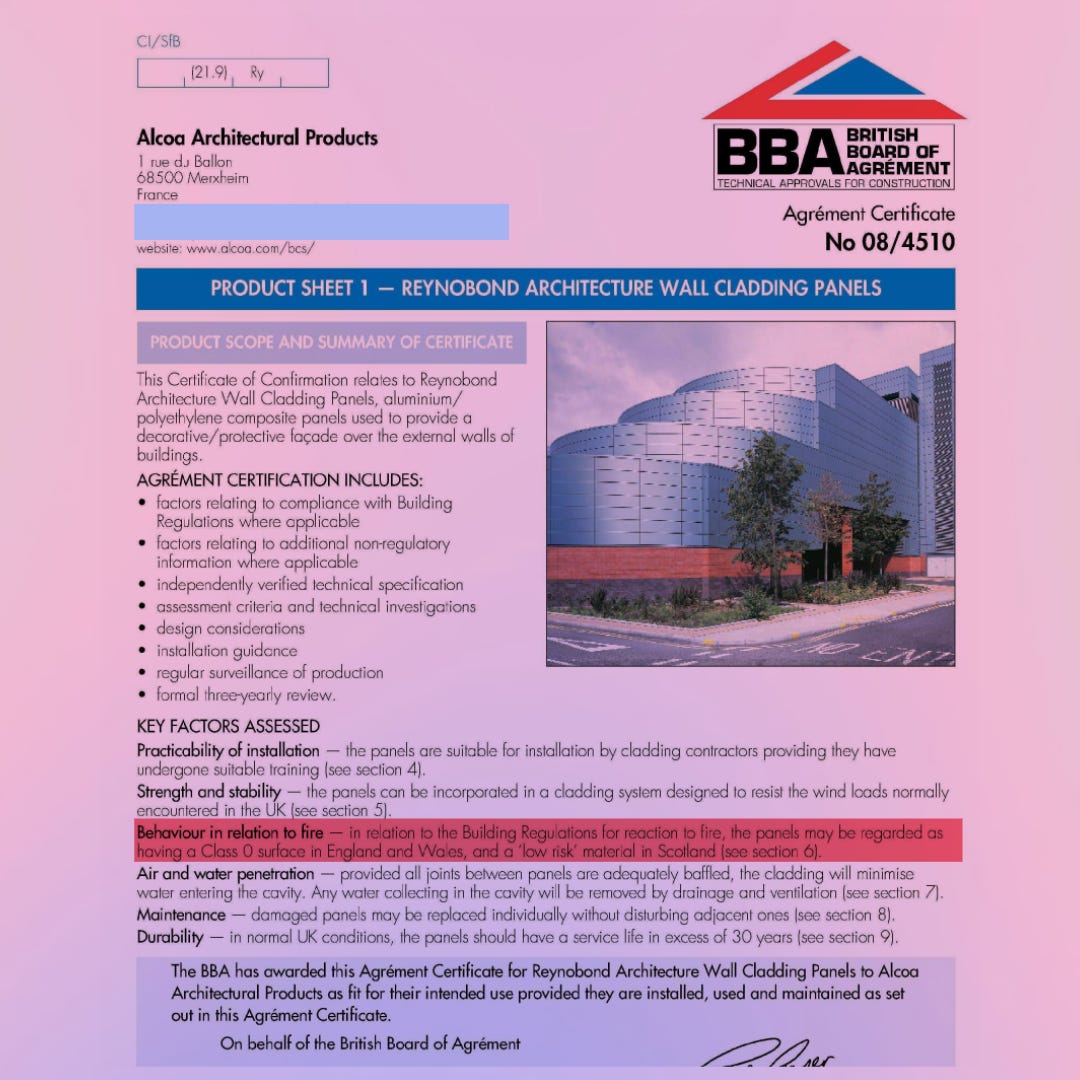
BBA certificate 08/4510 runs to a few pages. It is dated 14 January 2008. It covers Reynobond PE panels made by Arconic. And it contains one terse phrase
“May be regarded as having a Class 0 surface”
That sentence, printed on an official document stamped by the British Board of Agrément (BBA), will haunt experts for years. But it reassures architects, clients, inspectors. It allows these panels to go up on Grenfell Tower in 2015, 7 years after it was written, without anyone asking whether anything had changed in the meantime.
Something had changed.
But the certificate was still there.
To understand how a dangerous product becomes legal, you have to understand how compliance works in British construction. It is not a system of proof. It is a system of presumptions. Nobody demonstrates that a complete assembly is safe. You pile up elements that, taken one by one, look acceptable. A partial test. A surface classification. An extrapolation from one product to another. A certificate that says “may be regarded”.
Every document in the file looks solid. Nobody is required to check what happens when you put them together. A facade can boast a good surface class and, once assembled, turn into an accelerant. The “reaction to fire” of a material and the “fire resistance” of a structure are two different things. The system makes it easy not to dwell on the difference.
Professor Luke Bisby, a fire engineering expert at the University of Edinburgh, set it out in detail4. On Grenfell’s facade, several combustible materials had never been assessed. Polyurethane foam insulation panels dating from before the refurbishment. Synthetic rubber seals joining the windows to the structure. uPVC frames liable to melt and spread the flames. Compliance covered parts. The real facade was a pile of combustibles that nobody had ever tested together.
This system is not an accident. It is designed to work this way. And it works very well for those who know how to use it.
Arconic knew the risks. The internal emails, the technical warnings, the successive reclassifications: it is all documented. The question is not what Arconic knew, but what the regulatory framework let it do with that knowledge. In January 2014, the company officially reclassifies its product to class E, the lowest. Sales teams are told to stop using the class B rating. But nobody tells the BBA. Nobody withdraws certificate 08/4510. Nobody writes to the customers who have already bought the product.
This is not an oversight. It is a strategy. The certificate keeps circulating. And it keeps reassuring. The final report uses a precise phrase: Arconic sought to “exploit what it perceived to be a weak regulatory regime in the UK”5. The key word is “perceived”. Arconic did not create the loophole. It was already there. The company simply saw it and used it.
Barbara Lane confirmed6 during the inquiry that there was no evidence that the design team, RBKC building control, or the risk assessments of the landlord and the fire brigade had ever assessed the fire performance of the facade system as a whole. The actual assembly was nobody’s responsibility. Or everybody’s, take your pick.
But with Celotex, things go one step further.
Celotex makes RS5000, the insulation that will cover almost the entire facade of Grenfell. On 14 February 2014, the product goes through a standard fire test. The fire reaches the top of the rig in 26 minutes. The test is stopped. Fail. Three months later, Celotex tries again. This time, the configuration tested has been changed. 6 mm magnesium oxide boards, a non-combustible material, have been added. The test passes.
Extract from the evidence of a manager at Celotex
That test changes everything. Because Celotex obtains a BR135 classification, the golden ticket for high-rise buildings. The marketing material is redone. The product is now presented as “acceptable for use in buildings above 18 metres”. The data sheets circulate. Tenders are won. Harley Facades, Grenfell’s subcontractor, receives this documentation and uses it to justify its choice. Nobody knows that the test was passed with magnesium oxide boards that will never be fitted on site.
A former product manager at Celotex admitted it and spoke of “fraud on the market”. He explained that he knew he would have to lie for commercial gain. He thought it was standard practice. Debbie Berger, who succeeded him, found the photos of the test in her handover documents. She annotated the picture with a simple “WTF”. She said nothing. The product stayed on the market until nine days after the fire.
Until a fridge caught fire.